
Risk
How Fear of Intimacy Threatens Reality

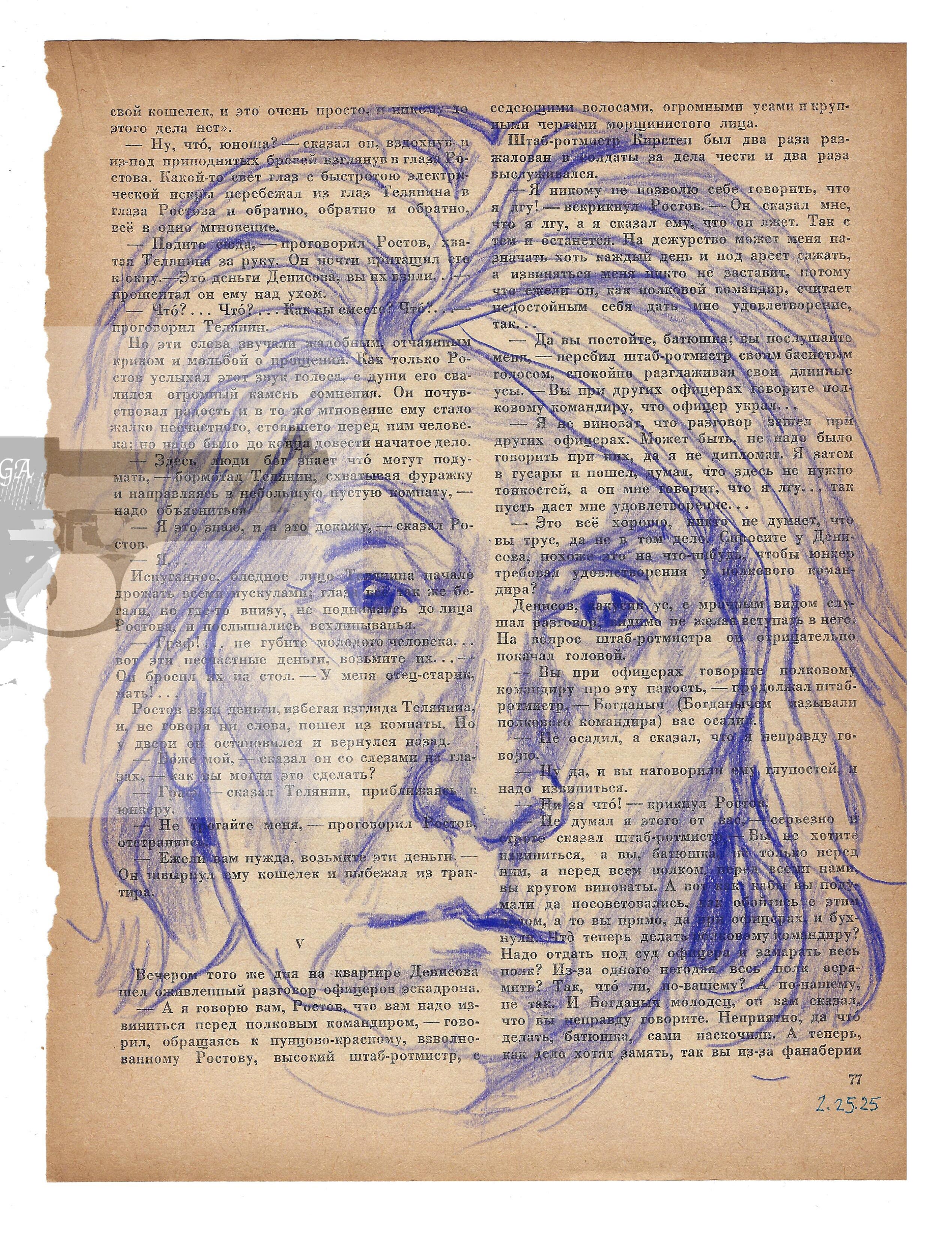
“Tolstoy & I February 25, 2025” Pencil on book pages 11”x 8.5” Aviva Rahmani
In the story of Dorothy and The Wizard of Oz, Dorothy’s world is shattered by a tornado and she finds herself in a strange world with three strange male companions. They each have an agenda they will realize: home, heart, courage and a brain.
Meanwhile, our real world seems to be undergoing its own tornado of shattering events: not just of climate cycles and the availability of fresh clean water, but intransigent calamities scattered across the globe: in Gaza, in Sudan, in Ukraine to name just a few. From what I read, many young men feel adrift in a shattered world of splintered gender identities. And in the United States, as in many countries, women are threatened more violently than they have felt in scores of years, by men who blame and punish them for their own discomforts, confusions and unhappiness. Besides the realistic dangers of either position for anyone: being adrift in life, threatening or being threatened by violent rage, none of these postures solve any real-world problems, of which there are too many to count right now, but all of which require a heart, courage and intelligence to safely come back to our common home from the strange world we all now inhabit.
I leave Wednesday to head to NYC for a show I’m in. The show I’m in is at the Anita Rogers Gallery. The opening will be this Thursday, Dec. 4 and it will be up Dec. 4-13. It will be the first public viewing from my “Tolstoy & I” series, a diary of drawings on the Cyrillic pages of my mother’s worn edition of “War and Peace.” I began the series to better understand our relationship to Russia today in the world. It has become a searching exploration of my own complex relationships to others and my self as a paradigm for what needs to change.
Gallery director, Elizabeth Thompson has several drawings from this series to choose from to show and I won’t see her choices till I arrive at the opening Thursday evening. Her choices include some from a smaller group in the same series, with a pistol (see lead visual). The pistol series were how I felt about what this American administration, the Manosphere and MAGA have been doing to women since the inauguration, what I think Leo Tolstoy did to his wife Sophia at times to assert his control over his own unruly feelings, and what, at times, I have felt in domestic or intimate relationships when people close to me sought to control my experiences: the inescapable acceptance that the risk of fear and hurt to the point of sickness unto death are sometimes normalized with impunity and are a risk in any intimacy.
Much of feminist writing has circled around the simple idea that men have more power over women than women have over men, primarily financially whether in bargaining for a raise or getting a good deal on a car. But also, most women of child-bearing age in the United States are at a disadvantage over reproductive health, as basic protective services have been withdrawn in battles to win the abortion wars. An unwonted pregnancy means physical vulnerability, particularly during child-bearing and child rearing. And then there is the ubiquitous threat of rape. The extent of these risks are less true in some states or nations than others. A tall woman might feel less vulnerable to rape that a petite woman. In some countries, femicide is routine, no matter how tall you are. Some women are brought up to feel fearless and some of those women, never experience the risk of a threat to their bodies, or their psyches. But most women do know they must be en garde against being in the wrong place with the wrong man at the wrong time. That includes when and how a woman becomes pregnant or in any other way vulnerable to circumstances she can’t control. In intimate relationships, some men can be demeaning and controlling. Of course, so can many women. But it is generally more socially acceptable for some men to voice misogynistic jokes, assert disrespectful entitlements and neglect a fair share of housework or emotional labor to maintain a relationship than it is for women to express the same aggression and negligence.
But women, including myself, have also found our own ways to fight back by swallowing back reactive anger, fear and disappointment, choosing to hit below the emotional belt with our own forms of control. Women as much as men can equally withhold affection, sex, tolerance and trust.
None of these conditions create a safe home. All can fester and destroy happiness and peace.
What does it mean to live with chronic fear, low grade resentment and the constant risk of emotional betrayal in your own home, whether you define the home within the walls of house or the expanse of a planet? The question could be asked of many groups: black people, immigrants, LGBT people ... So who does that leave that doesn’t carry the burden of everyday stress that comes from internalizing a defensive posture and picking up more psychological slack than is fair? Obviously, in intimate relationships, that leaves CIS white men, or at least those in the world who choose to pretend that de-Nile is just a river in Egypt.
Now this is the tricky part. Sentient CIS white men have their own demons if they are the slightest bit emotionally sentient. Many of those same dominant men have internalized their own toxic messages: that at all costs they must be in control of their feelings and their surroundings, that they cannot be vulnerable like all the other groups that are more vulnerable and if something goes wrong, it must be the fault of someone else, because owning responsibility is just too difficult, boring and painful. And too often, that also means men, usually more than women, are groomed for narcissism, brought up to feel entitled to control others, even as they hold in profound feelings of inadequacy, insecurity, deprivation and resentment for those feelings. These are the Tin Men of the world, those without a heart (because to own responsibility for one’s effects on others, not just oneself, is to have a heart). They are flanked by the cowardly lions, those who live without a conscience. And the scarecrow, without a brain, is absent. And so there’s a cycle of abuse. The distress of the dominant group does depend on intelligence, or rather whether their intelligence is used for self-aggrandizement or turned to a higher good, as the scarecrow in “The Wizard of Oz,” turned his intelligence to something inclusive when he aided Dorothy’s little group.
Where then is intervention possible to break these patterns and restore hearts, courage, minds and a safe home for all? Speaking from very personal experience, the cycle begins to break when each person is willing to engage in a dance of honesty and vulnerability. But that dance is also contingent on the willingness to invest empathy and tolerance over time. What would a world look like that isn’t dependent on who has power and control over another, whether another human being or another form of life, or even, oneself?
And where does art enter into it? For a long time, I have said that art can change the world. But of course, that’s not literally true. I was recently called on that: prove it. What art CAN do is reveal truths, illustrate hidden narratives, puncture denial and reflect what is being felt in a groundswell of changed attitudes. And that can reinforce or sway the opinions of others. It can’t help the Tin Men of the world to find a heart or the cowardly lions to find courage. That task is one that must come from desire. But desire can be stoked. Alternatives can be modeled. Those who eschew a good heart, honest courage and an intelligence grounded in respect and esteem for others, may be outnumbered one day by those who can envision a safe home and want to inhabit that world
In the “Tolstoy & I” series Sofia/ myself is inserted into Leo’s conversation with the world and with himself in his writing. His words are still legible but the presence of another person, and in the pistol group, the reality of fear tempers how we might understand that world, how we might countenance the presence of realities that challenge us all to find the correct answers for our future. Soon, in roughly 56 hours, I will begin to learn how an audience experiences that presence.