
Art Sees
Taking a good look at the future through the lens of art

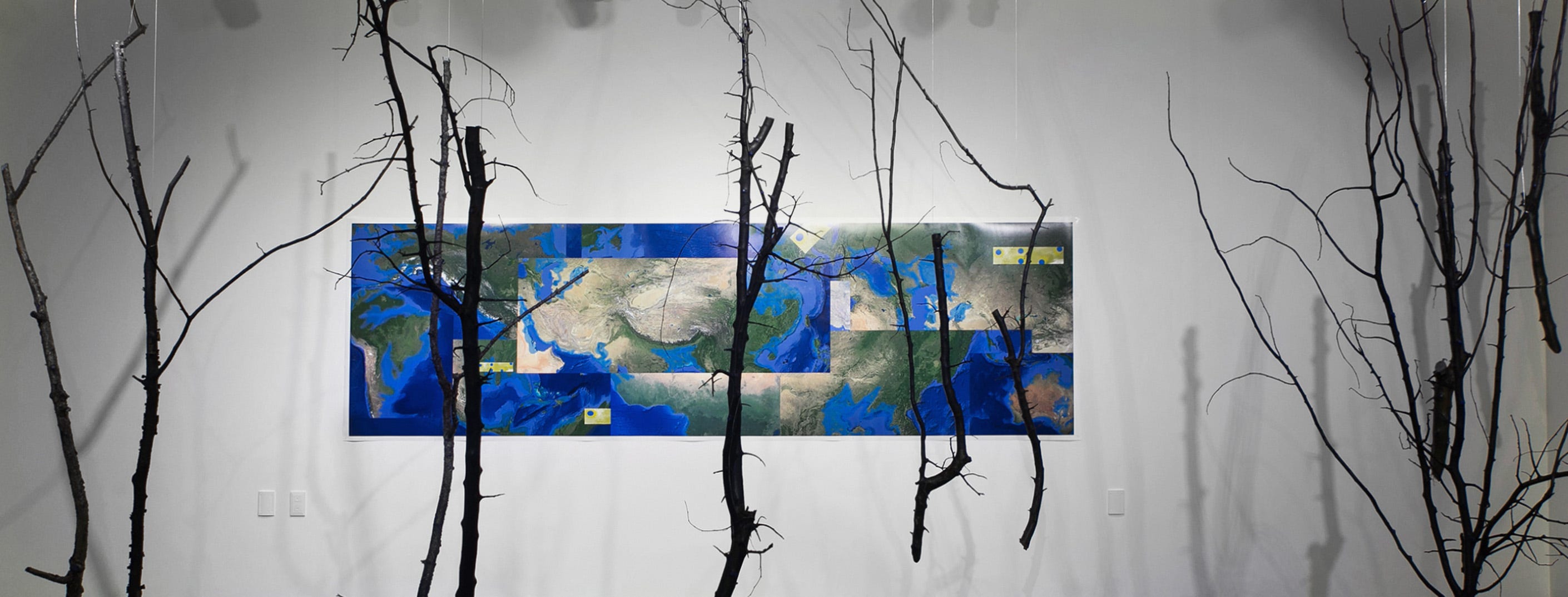
“The Blued Trees Symphony Global,” 2018 Daejeon, South Korea KRICT Gallery 10’x30’x15’
A substantial aspect of my practice studies and creates maps. Recently, I have been looking at maps of global patterns of drought. This isn’t something I am hearing much about. These patterns are being dramatically exacerbated by climate change.
June 1, I will begin a residency at SWALE House on Governors island, New Yor City. I will produce sketches for Tidal Flushing, my new intercontinental project about climate change. In HONGGEER, Inner Mongolia, I will expand The Blued Trees Symphony (2015-present), a copyrighted aerial symphonic score composed of “tree-notes” across miles of Noth America. The symphony challenges what Americans call the eminent domain rights of fossil fuel corporations. At the original Ghost Nets (1990-2000) site, which restored a former coastal town dump to flourishing wetlands and made it my home, I am considering relinquishing my wharf side studio to aquaculture farmers. In Daejeon, South Korea, I will open a show September 28 linking global patterns of drought and sea level rise to changes in Chongqing, China. Each of these sites are facing dramatic cultural and environmental changes in response to climate change.
It has always seemed to me that good art is about seeing honestly. Of course, the assertion of any truth in perception veers into long discussions of the philosophy of truth. But I am simply arguing for a very narrow aspect of truth, which is visual perception, determined by optics.
When I taught, I always used the example of perceiving a fist aimed at the face. if there is a direct line from the eye to the shoulder. The assumption with new artists, is that looks like a long rectangle from the knuckles to the shoulder. But thanks to foreshortening in depth, a form of perspective, the actual image will be an oval. The most famous example of the application in Western art of foreshortening is Andrea Mantegna’s The Mourning over the Dead Christ, which broke new perceptual ground at the time.
In 2022, I was invited to speak at Princeton. Before I accepted, I warned my hosts that I had no hope to offer. Spencer Koonin, one of the students who were inviting me replied. “We don’t need your hope. We need your honesty.” I decided I could do that. I have never thought seeing with an honest eye was simple but the task always inspires my curiosity.
Throughout this past winter and into the spring, I was developing the new work that has culminated with the launch of Tidal Flushing. The danger from drought is different at each site in form and scale but the consequences are similar: loss of arable land, threats to fresh water and fire hazards.
This past week, for the installation proposed in Daejeon, South Korea, curated by Yu Hyunju, I started studying international drought patterns in depth. In 2018, I had created another installation for Hyunju (see lead image), which included a photomontage of available land mass after projected sea level rise. What became obvious in that project, was that all terrestrial life could not fit on the remaining dry land and a lot of that dry land would be prone to drought.
A few years later, in a project called Fire Tigers for a digital residency with Arts Cabinet in the UK and modeler Olivia Haas at Kings College, we worked on global patterns of extreme fire regimes. It was no big insight that drought and fire go together. Now, as I work on drought, I am reminded of what I saw during that fire project.
Tidal Flushing began with my personal experience of sea level rise when the building my studio is in was threatened by storm flooding. But as the project has evolved, it has folded in the vulnerability of the island’s sole source aquifer, something that I worked on when I first came here in 1989. Going forward with aquaculture now to adapt to marine changes requires coastal fresh water. That carries freshwater risks for the rest of the island.
As I stare at the new maps I have of global drought patterns, consider the freshwater risks, think about fire regimes and what life is going to adapt to live with, I am also thinking about a big project I did with Jim White in 2007, Trigger Points/Tipping Points, for the “Weather Report” show Lucy Lippard curated for the Boulder Museum of Contemporary Art. That project revealed the scale of disruption from climate change refugees colliding with conflict zones. Now I feel both stunned all over again and confused. What stuns, alarms and shocks me is simple: we are facing an imminent perfect storm of global patterns without many solutions. Billions of humans will not only be climate change refugees at a time when authoritarian regimes are insisting the doors are shut, but uncountable other species are going to be trapped on land that may not be fit for agriculture, let alone grazing, with scarce fresh water and in imminent fire danger.
What confuses me is that no one is screaming bloody murder about this rapidly advancing apocalypse. Complaining about climate change can seem very abstract. Bickering about who started wars or hurled the worst insults is an enormous distraction from what seems to me to be rapidly coming down the pike in our lifetimes. Trips to Mars and AI are not going to fix any of this reality. It also doesn’t help that we seem to be mainlining totalitarianism at the cost of dissenting opinions. Most of the dissenting opinions being sacrificed have been challenging the status quo, the same status quo that has brought us to the brink of this precipice. The priorities of tyrants rarely include the needs of ordinary people unless you consider sticking your head in the sad to be a viable lifestyle.
Are we really, really, really this stupid?
But then really, when I consider the drawings of global drought I’ve been staring at, I admit I didn’t see the pattern either until it stared me in the face. Well, I see it now. I just wonder whom else sees something but maybe isn’t talking about it. What I am pretty sure about, is that the future I saw in Daejeon in 2018 is coming closer, faster and not too many people are are paying much attention. What I foresee is a real train wreck if that continues, much worse than what most of us are suffering so far but maybe not so different than what we have already witnessed of global conflicts and scarcities. Just, more.
Your work masterfully reframes the climate crisis from an abstract data point into a visceral, situated reality, echoing the feminist necessity of witnessing what power prefers to ignore.